Showing posts with label classic rereads. Show all posts

Saturday, October 15, 2022

Classic Rereads: Nicholas on vacation by Rene Goscinny, illustrated by Sempe

Goscinny, of Asterix fame, wrote a series of books about a boy called Nicholas. There's no definitive plot, just vignettes. Hilarious vignettes. Squirt milk out your nose and laugh until your stomach aches vignettes.

Nicholas is supremely unconscious of the world around him - and lives comfortably amid the mayhem he creates, while his parents, his teachers, and adults in general collapse in exhaustion and frustration around him. This is my favorite collection of Nicholas stories, featuring Nicholas' version of a family holiday on the beach and summer camp with his friends. Nicholas has a great time - it's too bad all the adults seem to be tired all the time....

Sempe's illustrations are quick, comic sketches that capture the hilarity of Nicholas and friends, their childhood squabbles, and the exasperated reactions of adults all with a few quick lines.

This series is apparently very popular in France and is used in language classes. Sempe is a well-known comic artist there (along the lines of Charles Schulz I think).


Who will read this? I've never been successful in getting kids interested in this series, although what I think of as a contemporary comic version, Toto Trouble by Thierry Coppee, was briefly quite popular in my library (I imagine the sudden drop in popularity was due to parents reading it. The first book is called "Back to Crass" for a reason). It requires a more sophisticated sense of humor and is really aimed at adults.

Bring it back? Alas, I think the only market is really adults, especially those who wax nostalgic over the humor of series like Crompton's William. However, Phaidon periodically reprints it so those of us who appreciate French comics and humor can enjoy.

Availability? Phaidon did a run of really nice hardcovers about 10 years ago that are now out of print. Used prices online range widely. Some paperbacks were republished in 2019 and there are now Kindle versions available.

Thursday, August 11, 2022

Classic Rereads: The Big Smith Snatch by Louise Jane Curry

Going retro for the moment....this story was quite different from most of Jane Louise Curry's books I've read. My favorites of hers are her stories of Mindy, which are sort of magic science meets the Borrowers and her mysteries. This is a mystery, but mostly a kidnapping one.

A family with a large number of children are in a rather sticky spot - Dad has gone from California back to the east coast for a possible job and they haven't heard from him in a long time. Their money is running out and their mother is pregnant and sick. When she collapses, all of the children except the oldest girl get picked up by social services. They manage to stay together, but just when they're congratulating themselves on the trick they played to keep from being separated, they begin to realize that the foster family they're with may not be as nice as they seem and they're in more trouble than ever. It takes their older sister, a former bag lady, and some frightening adventures before the family is reunited and all is well again.

Verdict: An interesting story, but it won't replace my favorite Currys.

ISBN: 978-0689504785; Published September 1989 by Margaret K. McElderry; Available as an ebook

Classic Rereads: Henry the Explorer by Mark Taylor, illustrated by Graham Booth

"On the night of the blizzard, Henry and Laird Angus McAngus read an exciting book about exploring. So...the next morning, after breakfast, Henry got ready to go exploring. He carefully made ready his explorer's kit. And he made a great many flags in order to claim all the wonderful things he planned to discover."

Thus begins the first Henry and Angus book, a lovely picture book series of imagination, discovery, humor, and adventure. In each story, Henry's bedtime reading provides the impetus for a grand exploration the next day. Graham Booth's illustrations show a sturdy boy, suitably clad for his various expeditions, and marvelous landscapes, full of color and mystery. My personal favorite illustration of the Henry books is Laird Angus McAngus. Looking like nothing so much as a shaggy footstool with eyes. Angus solemnly follows Henry on all his adventures, faithfully carrying the necessary little flags, with perpetual circles under his eyes. After all, living up to a boy like Henry is tiring!

If you fall in love with Angus, he has his own series, The Secret Life of Angus, where he investigates mysteries, such as The Case of the Missing Kittens.

Alas, I must admit that these books, published from the mid-60s through the 70s are out of print. But it would be well worth your while to dig through your library system and see if you have any. They are humorous and exuberantly illustrated stories of imagination, resourcefulness, and exploration! They show that reading is just the beginning of new and exciting discoveries!

Verdict: I love these books so much...but they are just not what modern kids and parents look for. The lush swirly illustrations and lengthier text are a far cry from the clean-cut pictures and brief language of the modern picture books. Find them for your own gratification, if you like this type of picture book.

ISBN: 978-1930900486; Published October 2011 by Purple House Press (this is a reprint, I'm not sure how faithful a reproduction it is, but it's in print!); Borrowed from the library; Sadly, had to weed this and other Taylor titles due to lack of circulation and general grottiness, but I took them home and added them to my personal collection, so they are still in use!

Classic Rereads: Johnny Castleseed by Edward Ormondroyd, illustrated by Diana Thewlis

This was one of my favorite books as a child although objectively it's nothing memorable. Ormondroyd has written many much better books, the text is lengthy and the illustrations are rather bland and a bit outdated. A little boy and his dad walk through the woods to the beach, where they have a picnic. Evan tells his dad about Johnny Appleseed, whom he learned about in school, and his dad tells him about Johnny Castleseed. Evan isn't quite sure he believes this, but once he and his dad get started building a magnificent castle, sure enough Johnny Castleseed shows up.

What I really love about this story is the part where Ormondroyd abruptly transitions from the stilted interactions between parent and child and speaks directly to the reader, showing you how to create an amazing sand castle with just your hands and some water and sand. This is, happily, the bulk of the book and it's absolutely fascinating. The illustrations of the sand castle are alluring too, a nice blend of softened colors and photographic realism.

Bring it back? This is out of print and generally outdated, but it's worth tracking down a copy to take a look before a beach visit for the sandcastle instructions.

ISBN: N/A; Published November 1988 by Houghton Mifflin

Wednesday, August 3, 2022

Classic Rereads: Maple Hill Farm by Alice and Martin Provensen

I discovered the Maple Hill Farm books as a tween I think, so some time in the 90s. Yes, I was a teenager who liked to read picture books. I loved the illustrations, the sly humor, and the tone of the books. They're also great for tracing the pictures (I have no idea why I was interested in that; I can't draw and have never been particularly interested in art).

We had several of the original books at my library, but they were ancient, worn, and had long since ceased to circulate. I put them on a list of books that I would like to purchase when/if they were ever republished. Now that at least one is back in print, I think it's time to look at them and see if they're relevant for our modern library audience.

An Owl and Three Pussycats was originally published in 1981 and A Horse and a Hound A Goat and A Gander in 1979. As you might guess from the titles, both are overviews of "some special animals" that live at Maple Hill Farm. The books are oversized, with plenty of room for detailed progressions of the animals, like this hilarious page of cat illustrations.


These are more detailed looks at the animals shown in the two overview book. Our Animal Friends, originally published in 1974, and The Year at Maple Hill Farm, 1978. Our Animal Friends is also oversized, and covers a variety of animals, some now dead and some living. It lists the cats of An Owl and Three Pussycats as dead and doesn't really mention the horses. It also has a list of "some of the dogs" that have lived there, with some being "put away." "This dog killed sheep and had to be put away (as the saying goes). This dog snapped at children and wet on beds. He is not around any more either."

The Year at Maple Hill Farm is most often seen in a small paperback format, but does also come in an oversized binding like the others. It presents a scene and animals from each month at the farm, leading to the next. In May the animals get haircuts, in June the pond is full, in October the pumpkins are harvested.

Our Animal Friends and The Year at Maple Hill Farm have both been recently republished in paperback and prebound format. Are these worth the investment? The prebound copies run close to $20 apiece, which is almost twice what I normally pay for picture books. While I love the nostalgic illustrations, brisk, matter-of-fact narration, sly humor, and lyrical descriptions of place and seasons, they are lengthy and a bit too blunt about life and death for most of my audience.

Sadly, these are ones that I will probably let pass by. I am happy to have them in my personal collection and I think in a solidly rural area or somewhere with a lot of family farms they would be appreciated. We do have both, but they are not the bulk of our audience, which tends to be more small town suburban.


Classic Rereads: Alistair (series) by Marilyn Sadler, illustrated by Roger Bollen

Aliens! Monsters! Lost Library Books!

Alistair is a Very Good Little Boy. He's always clean, always on time, always organized. He always knows just what to do. Which is good, because this Very Good Little Boy ends up in some straaange situations. Only Alistair, on his way to return library books, would get kidnapped by aliens! (Fortunately, he's an excellent navigator and gets them all home safely). Only Alistair would end up with an elephant, find previously unknown monsters while scuba diving, or be able to deal with an alien invasion.

The completely insane situations contrasted with Alistair's consistently deadpan face and Very Good Behavior, will keep you giggling all the way through!

Verdict: Although these books are older, they're not at all outdated. Great fun if you find a used copy or buy the still in print paperback.

Revisited: Sadly, even the paperbacks are out of print now. I still find these hilarious and some shiny new editions, possibly with minor updates to the font choices, would be sure to appeal to school age kids who still enjoy funny picture books.

Friday, July 22, 2022

Classic Rereads: Church Mouse by Graham Oakley

I discovered Graham Oakley's Church Mouse books when I was a teen and fell completely in love with their dry humor, quirky detailed art, and hilarious 80s UK vibe. I gradually collected nearly all of them for my personal collection, but eventually had to admit that, like many vintage books, they have not aged well for today's audience and other than adult fans, it's unlikely that they will be of interest to the average picture book reader. If you are interested in revisiting the stories, or introducing them to kids and seeing what they think, I believe the reissue is still available direct from Kane Miller.

[My original review of the reissue in 2010]

Finally! Finally, they are republishing the Church Mouse series by Graham Oakley. Kane Miller, you are the most intelligent, perspicacious publisher ever! I am a huge, huge fan of Arthur, Humphrey, Samson, and all the mice and villagers of Wortlethorpe. Of course, us true devotees of Arthur and his friends are really interested in only one topic....how does the reprint compare?

You will have to forgive my truly abysmal photographic abilities. The pictures will enlarge if you click on them, but I'm not sure that's a positive thing or not. So, the cover. The original cover here, as owned by me and complete with Half Price Books price tag I never took off, is a close look at Sampson and Arthur, best friends forever. The new cover, pictured above, shows Arthur addressing the mice and inviting them to come live in the church. Naturally, I am sorry to lose the original cover, which isn't contained in the story, but I do like the way the pattern on the new cover matches the tile pattern on the old and the new endpapers - very, very nice indeed. I was sorry to lose the black and white outline drawings decorating the title page and end page, but that's a small quibble and the colored replacements are quite nice.

We open the book and...whoo! Same illustrations, but brilliantly restored and glowing with color. The bus is a brighter red, the trees a deeper green, gorgeous! The new edition has framed all the illustrations and text and added a plain border while the old edition (which may differ from the original, a copy of which I don't own) has the text embedded in the art, as you see below, new on the left, old on the right.

To accommodate the new panels and outlay, some of the art has been resized and the type is quite a bit smaller. There are several trifling changes in the text - original, "Straight away she asked him in to meet her husband for she knew that anybody who lived in a church must be a pretty decent sort of person" new edition, "Right away she asked him in to meet her husband, for she knew anybody who lived in a church must be a pretty decent sort of mouse."

However, the textual changes are minor. The resizing of the text and illustrations isn't really a drawback - this story is too long for a normal storytime anyways and is really intended to be pored over by a few chortling children and the passing adult as well. I like the idea of the panels, as I think it will grab children used to reading graphic novels and comics and attract them to this delightfully sarcastic story. Most of Oakley's humor comes from the juxtaposition of his incredibly detailed and humorous art with his straight-faced prose and the new layout does an excellent job of making the story easy to follow and accessible.

So, while I may lament a few minor changes, I'm very happy with this on the whole. Beautifully restored art, a fresh and snappy layout, and a beloved series is available to a new generation!

Source: Review copy provided by Kane Miller through Raab Associates.

Verdict: This won't circulate like a Fancy Nancy, but there will definitely be a firm and devoted group of supporters for this lovely new edition. Buy it for adults to rediscover and to delight a new generation of children!

ISBN: 978-1935279693; Published September 2010 by Kane Miller (reprint); Review copy provided by the publisher through Raab Associates

Below is a piece I originally wrote in high school and later adapted and edited in graduate school.

The first of the church mice stories by Graham Oakley sets the style and pace for each of the further adventures of the hilariously human mice. Arthur, the church mouse, feels lonely with only reformed cat Samson for company and invites all of the town mice to move into the church. At first, all goes well; the mice help out in return for cheese and life is good. But when Samson falls asleep during the Vicar’s sermon, the mice’s arrangement is ruined. However, thanks to a fortuitous burglar, Samson and the mice redeem themselves and there is a happy ending for everyone. This picture book is most suitable for children able to appreciate the ironic humor and detailed pictures, but will also be enjoyed by younger children, who can follow the action through the illustrations, and older children who will catch the sly jokes embedded in the text and illustrations. It is not suitable for large groups, as the pictures are fairly small and detailed.

The format of the illustrations and text shifts from page to page. The first page is a full-spread illustration of the village seen from above, with the single sentence of introductory text inset in the corner. The village is a mixture of modern and medieval, the older architecture of the houses and shops mixed with television aerials and cars, giving a picture of a traditional village moving comfortably into the modern world. The lines of the drawing direct the audience’s attention to the church, showing its central importance to the village and the story. After this introduction to the general setting, the rest of the story is told in illustrations of varying sizes interspersed with blocks of text. All of the illustrations are strongly realistic in style and the broader panoramas have the slightly fuzzy quality of a watercolor or unfocused photograph.

These individual illustrations tell a story of their own, at times paralleling and enhancing the narrative contained in the text but more often providing a humorous reinterpretation of the apparently bland narrative. For example, in the second coupling of illustration and text, the words read alone are without particular interest, “Arthur liked living in a church. For one thing, he was very fond of music, particularly if it was loud.” However, added to the picture of Arthur balancing on an ornately carved pillar directly in front of the organ’s pipes, his tail and whiskers streaming out behind him, eyes closed in ecstasy and conductor’s baton raised, these simple phrases become subtly humorous. Other small touches, such as Arthur meditating while perched upon the nose of a statue, perfectly express the dry wit of the story.

The illustrations have a strong background of earth colors, the multitudes of gray and brown mice, their colors shifting with the surrounding setting, the stone and brick of the church, the deep orange of Samson the cat, all linking the animals to the country village and maintaining its rural flavor. However, dashes of bright color hint at increasing modernization, as seen in a bright red car and the sometimes garish clothes of the villagers. In the third section of the narrative, after Samson and the mice’s disgrace, the illustrations shift the story, first changing in format to cover double pages and allow for larger blocks of text, but also reemphasizing the earth colors in the wood of the empty church and then warming into the evening fire and Samson and Arthur’s miserable disgrace. After this transition, the story shifts back to the sets of illustration and text, all of the illustrations being drawn in blue and white shades showing the night-time action of the burglar and his apprehension by Samson and the mice.

A great deal of the humor of the story derives from the detailed expressions on the character’s faces. Although the mice remain a largely anonymous group, excepting only Arthur and his new rival and sometimes friend Humphrey the school mouse, each mouse is drawn with a specific expression and role in each individual illustration. They are lifelike in their general anatomy, but anthropomorphized in expression and movement. Their strong communal attitude is expressed in their consistent portrayal in groups, both large and small. Samson also contributes to the hilarity of the tale, continuously being drawn into the mice’s plans against his will, as can be seen in his patient but at times bewildered expression.

Although in some ways the book could be considered outdated, especially in the clothing of the townspeople and a few British cultural references in the text, the innate humor and action of the story and illustrations remains. Younger children especially will enjoy the narrative and action of the pictures themselves, as the groups of mice alternately argue and cooperate in their tasks and adventures. This is a story children can enjoy again and again, finding new elements as they grow older and catch the irony and sarcasm conveyed by the combination of text and art or discover hidden jokes in the illustrations themselves.

Wednesday, April 20, 2022

Classic Rereads: Look Through My Window by Jean Little, Illustrated by Joan Sandin

One of the first reviews I ever wrote was of Jean Little's Look Through My Window - also one of the first novels by Jean Little I read. I can still remember exactly where I was and how I felt as I read this story of friends, change, and growth. This was written when I was about fourteen!

Emily's life is predictable and normal. The most exciting thing that ever happens to her is being home along for a few hours. But then her aunt becomes ill and she and her parents move to the country, to a big, old house, to care for her four young cousins. She's attending a new school for the first time and is determined to be someone different, someone new. She's spurred on by the discovery of a mysterious box and hopes to make a real friend.

But the first person she meets is prickly Kate Bloomfield. Kate has one adult sister, so is virtually an only child. She sticks out in the suburban/rural area like a sore thumb; her father is Jewish, but doesn't practice, her parents are both very "modern" and run a bookstore. Kate is confused and often bitter and feels like she is unwanted by her family and doesn't fit in anywhere.

Between Emily's mother's struggles to adjust to life with four rambunctious children, and all the emergencies and catastrophes that ensue, both Kate and Emily slowly change and grow, discussing who they are, writing poetry, finding what they have in common as well as what's different about their lives. Kate especially questions her parents' religious choices and her own identity, while Emily is more sure of herself even when she makes missteps. The girls work their way through their own family issues as well as their religious differences, figuring out how to be more than casual friends and learning that they both still have a lot of changes to expect in their life.

Who will read this? Fans of Tara Altebrando's middle grade books and other quiet, reflective stories of girls coming of age.

Bring it back? Absolutely. The book addresses questions like religion and identity not often touched on in middle grade titles and sketches in a dreamy summer with a slowly growing friendship with an expert hand. The story is timeless, needing no updating. The only thing I would change is, much though I love her classic illustrations, Joan Sandin's art should probably be swapped out for something a little more contemporary, at least on the cover.

Availability? Sadly, this has been out of print since the 70s and it's unlikely to ever see the light of day in the US again. Periodically, I check to see if Canada has brought out any new or reissued Jean Little titles, so that's a faint possibility some day!

Friday, April 8, 2022

Classic Rereads: The Saucepan Journey by Edith Unnerstad, illustrated by Louis Slobodkin

I have searched for many years for the Peep-Larssons Go Sailing by Edith Unnerstad. Recommended by Noel Perrin as one of those rare, but exquisite books, I've never quite managed to get my hands on a copy. But I finally decided to read another in the series, The Saucepan Journey, and located a copy via inter-library loan. It turned out to be the first in the series!

The Larssons are poor. They have so many children there's scarcely room to turn around in their tiny apartment, let alone sleep. When their father's rich half-brother dies and leaves them only two draft horses and drays, Mrs. Larsson comes up with a novel idea - Mr. Larsson, who is an inventor when he's not a traveling salesman, will turn the wagons into caravans and they will spend the summer touring the countryside. Where does the Peep come in? Well, Mr. Larsson has designed a marvelous saucepan, and they will finance their journey by selling it along the way.

It's a wonderful summer. They meet a down-on-his-luck hot dog man, an eccentric old woman, a man who might be a murderer. They discover thieves, wonderful lakes, and fascinating Swedish towns.

Who will read this? Families who enjoy classic family stories such as Taylor's All of a Kind Family, Sidney's Five little Peppers, Eleanor Estes, and Streatfeild's Magic Summer will love this. It won't appeal to kids who are used to the more fast-paced adventures of contemporary children's literature and media, but you might be surprised how many kids are willing to relax and try something different. It's a perfect family summer read, and may be especially appreciated by families who struggle economically or who want their children to be familiar with a wide range of people in different walks of life.

Bring it back? For my library, it would be a great fit. Even if you're not fascinated by Scandinavian children's literature, as am I, this is a wonderfully nostalgic summer read. While it lacks racial diversity, not surprising for the time period and location, it portrays a family that is poor in economic resources but rich in imagination, ingenuity, and love. The original illustrations are colorful and appealing and it's a strong family story that will appeal to readers who like this type of lazy summer reads.

Availability? It's fairly common in smaller libraries - worldcat lists multiple holdings. Used copies also proliferate online for a reasonable price. Unfortunately, it was last reprinted in the 60s so you're unlikely to find a shiny new copy that will stand out on the shelf.

Tuesday, March 29, 2022

Classic Rereads: Need a house? Call Ms. Mouse! by George Mendoza, illustrated by Doris Susan Smith

[Originally published 6-8-2012]

This isn't so much a review as a paean of joy to that special moment of rediscovery when you find a book you'd loved as a child.

Reading aloud was a huge deal in my family, at least for the older kids. One of my few memories of my grandmother who died when I was twelve is of her reading a Christmas story to us. My mom used to walk us to the library and bring back a wagonload of books. She read aloud to us as a family - as did my dad - until I was about eleven and figured out that I could read faster silently than my parents could read aloud, and promptly sneaked the current read aloud and finished them off on my own. Then I read aloud to my younger siblings. I also picked audiobooks for our longer commute. Some of them were appreciated, but I finally gave in and didn't make my brothers finish listening to Anne of Green Gables and the unabridged Robinson Crusoe gets pretty blah after he's rescued.

So I have a vast number of books lurking about in the back of my brain. Especially picture books from the 1980s when I was a child. Some of these are, to put it mildly, odd but I love them anyways. Like Jon Buller's Fanny and May, about two elephant sisters, one of whom just can't control her appetite...and eats their house. Which is made, naturally, of cake.

Or there's my beloved Tangle and the Firesticks by Benedict Blathwyt, which tells the story of a misfit miniature furry creature. The real draw of course, is all the tiny things in the illustrations...

The best moment in rediscovering a childhood book love is that moment when you pick up a book and suddenly realize you've read it before. And all the delight you felt reading it as a child floods in.

So, finally arriving at the focus title of the random meandering...I have no idea why Need a House? was on my to read list. I might have seen it on some blog...or it could have been a leftover from one of my many lists. In any case, I requested it from inter-library loan with no recollection of ever having seen it before. I looked at the cover and thought, "hmm, that looks kind of familiar" opened it up and...

ohhhhhhhhh, the love! I loved, loved, loved this book. It has two of the things I loved most in picture books as a child; small, detailed drawings and organization. Yes, a cataloger from my youth... Ms. Mouse, a brilliant career mouse, designs houses for all her friends. The text is pretty blah - and I don't really remember reading any of it. But the pictures...ohhhh, the pictures. Just looking at them makes me so happy. It's like a combination of Jill Barklem's Brambly Hedge miniature books and Doris Burn's Andrew Henry's Meadow, with the houses designed for each child (both were also favorites of mine). Ms. Mouse not only builds a different style of house for her friends, many of them are also set in different cultures. So Cat has a Japanese-style house with sliding doors and an inner garden courtyard set high in the mountains, where he can lazily sun himself on the open terraces and fly his kite. Trout has a kind of formal French garden maze set with coral hedges. If I knew more about architecture I could probably identify the other places, but you don't need to be an expert to fall in love with this book.

Interestingly, when I was looking for some pictures, I found an old design blog with some of the interior illustrations. You can check them out here.

Alas, I must now return this gem to the library from whence it came, but I've had another lovely "oooohhh" moment and now have a new book to add to my childhood favorites wishlist.

This is long out of print and used copies run to hundreds of dollars. I don't know that it would necessarily appeal to today's children, but the nostalgia value is high and I think there would be a large market for it, should any publisher bring it back.

Saturday, March 26, 2022

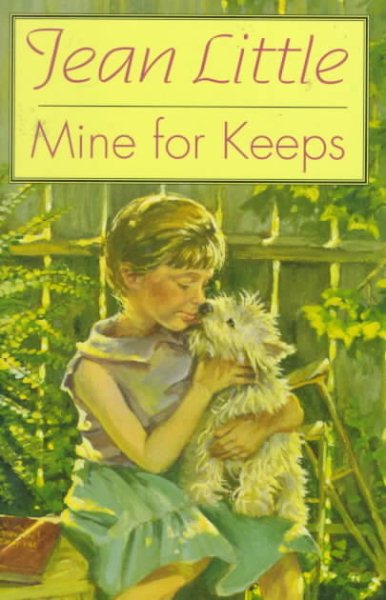
Classic Rereads: Mine for keeps by Jean Little

Sally has cerebral palsy and has been living at a special facility for children with disabilities for five years, but now she's finally coming home to stay. She's excited, scared, and worried all together. Her family is familiar and yet strange and there are so many new things to navigate, from getting dressed by herself to going to school. When she gets a dog, at first it seems like one more thing she can't handle, but together they slowly change and grow until Sally changes from being "Scarey Sarah" and her dog Susie changes too. Together with her friends, she learns to fit into her family and her new world.

This is such a solid book book from the perspective of a child with a disability. How often do you see that? Not the foil for the main character, not the plucky friend who gives wise advice to the main character, no, the main character herself! Sally is a real little girl, not defined by her disability, but not unaffected by it either. She has to struggle to be independent, to do the things that others find so easy. She's not a cardboard cut-out child - she gets upset, doesn't try, feels angry and worried and scared. Her family and friends are perfectly cast and are just as real as Sally is. They don't have perfect lives any more than she does and, if there was a lesson to this book, it would be that everyone has their own difficulties to overcome.

Who will read this? Kids who like realistic and family stories.

Bring it back? Yes. I've never really found another author who wrote so simply and realistically about children with disabilities as Jean Little. It would be amazing if publishers would update some of the factual information and a few references to clothes etc. and republish these with new covers.

Availability: This was last republished in the US in the 1990s by Viking but was republished in a paperback edition in Canada in 2008 with a new cover. I don't know if any aspects in that edition were updated. I'd love to see a new US edition available.

Thursday, March 17, 2022

Classic Rereads: Alice's Birthday Pig by Tim Kennemore


I first discovered this funny beginning chapter book trilogy almost 10 years ago. Not only was it hilarious and spot-on, it was not overwhelmingly British and it has a guinea pig!

Alice, in addition to her wacky little sister Rosie and her supercilious older brother Oliver, has a problem - she can't pronounce "animal". When her teacher announces that the class topic will be farm animals, Alice gloomily looks forward to a semester of teasing. And when her class takes a field trip to a farm and Alice finds an unexpectedly adorable little pig, she knows that more disappointments are in store. However, in a surprise ending, Alice gets her a pet, Oliver is vanquished, and even Rosie is temporarily dismayed.

This is a classic "in the middle" story; Alice's trials and triumphs as a middle child and her longing for a pet of her own will resonate with children no matter their birth order! The illustrations are sweet and just a little zany, just like Alice's family.

Who will read this? Beginning chapter readers who are fluent but not ready for longer books; kids who enjoy funny family stories, and any kids who have sibling woes.

Bring it back? Well....I'd love it to be available, but I have to admit it has not circulated in my library as I'd hoped, even when I used it for a book club. It's a little challenging for the reading level of most kids who are reading beginning chapters and there are a lot of beginning chapter series out there. It's a great read-aloud but there are plenty of copies still floating around.

Availability? The trilogy is out of print, but it's available as a digital audio (which I personally own) and I eventually weeded the books, so it's no longer available in my consortium.

ISBN: 978-0802853356; Published March 2008 by Eerdmans

Saturday, March 5, 2022

Classic Rereads: Spring begins in March by Jean Little

One of the things I love about Jean Little's characters in her realistic chapter books is her ability to look at the same situation and characters from completely different viewpoints. In Mine for Keeps she shows Sally, a girl who has cerebral palsy and is coming home after living at a residential facility. Her struggles to be independent, to become part of her family again, to have friends and function at school are defined through her dog, Susie, who is painfully shy and has a lot to learn. Sally has two sisters, bossy older Melinda and wild baby Meg.

Now it's Meg's turn. She's older now and Sally is the perfect older sister who always does everything right. Nothing goes right for Meg. She's failing in school, constantly daydreams, and when it looks like she's going to get the one thing she desperately wants, a room of her own, it turns out she's going to have to stay with Sally because Grandma Kent is coming to live with them. After many painful struggles, Meg and her new dog Robbie, who is also a "wild child," finally begin to see new hope with help from friends and family and their own courageous determination.

Although this story was originally written in the 1960s, it is still spot-on. Meg's struggles at school, her desperate feeling that everything she does goes wrong, her clashes with her grandmother and sisters, every one is something a modern girl can completely sympathize with. I've looked at several books showing extended families having to move in together because of economic circumstances, but this is the one I'd choose. Same thing for dealing with school difficulties. Maybe in a modern school Meg would get testing and extra help - maybe not. Either way, it's her own determination and the love of family and friends that finally starts her on the way to fixing all the things that are going wrong.

Who will read this? Kids who like realistic and family stories.

Bring it back? Yes please! We need more books showing families struggling with finances, kids who struggle in school, and the encouragement of resilience in kids' personal lives.

Availability: A later paperback version was published in Canada, but there are currently no available editions. You can buy it used though.

Saturday, January 15, 2022

Classic Rereads: Pippi Longstocking by Astrid Lindgren, translated by Susan Beard, illustrated by Ingrid Vang Nyman

  This is a new translation of a classic children's story, with the original illustrations included. Most people have at least a general idea of the story of Pippi Longstocking, but the real question is, does it stand up to the test of time?

Pippi Longstocking, conceived as a series of episodic stories told to Astrid Lindgren's daughter, has that peculiar quality of bedtime story that incorporates the unheard interjections of "and THEN what happened?" from an eager child. Pippi is an eccentric and quirky character, immensely strong, with a chest of gold coins, a pet horse and monkey, and her own way of doing everything. She represents absolute freedom to her more conventional neighbors, Tommy and Annika, as she defeats robbers, runs wild at school, and takes over a circus. Nyman's classic black and white illustrations show a diminutive girl with wildly tousled hair, and the classic Shirley Temple style dress of the time period, showing her pants underneath and the garters holding up her mismatched socks.

Originally, adults objected to the Pippi stories because of her wild and ungovernable behavior. She interrupts tea parties, doesn't go to school, and has no manners, tells wild stories, and any attempts by adults in her town to regulate her life lead to their complete humiliation. However, most people realized that she was never intended as a role model and is a wish-fulfillment figure, a fantasy of free living. Even Tommy and Annika, who represent the conventional child, while they find her fascinating also find her a little frightening and often need a break from her company.

However, what I was looking for in this new translation was how the racism of the original was handled. As in many classic European stories, people from countries outside of Europe are treated as exotic animals. In the original, Pippi is sure her father is now a "cannibal king" in the south seas and tells a series of exaggerated whoppers about the countries she's visited, many of which incorporate strings of racist imagery and stereotypes of the people there. In this new translation, Pippi's father is now a "south sea islands king" which I'm not sure is really an improvement, but fairly innocuous. Many of her wild stories are toned down or left out (I think - I might be thinking of stories from other volumes, since she tells the stories throughout all four books), but one in particular, based in China and incorporating several racial stereotypes, is left in.

Verdict: I have no problem with editing older children's "classics" for a new generation. Pippi's stories, in particular, could easily have been left out completely without changing the sense of the story as a whole and I was disappointed that the Chinese one was left in. If you have a large audience for older fiction or feel a need to have this particular title on hand, this is one of the more innocuous translations you'll find, but it could have been better.

ISBN: 9780593117811; This edition published August 2020 by Viking/Penguin; Review copy provided by publisher