Showing posts with label picture book - informational. Show all posts

Monday, November 4, 2024

Guess what it is: Shadow Play and Hide and Seek in Nature by Helena Harastova and Serafima Kosikava, translated by Andrew Oakland

 This is an interesting set of guessing game titles, using strategically placed cut-outs to encourage kids to guess the answer to various natural objects.

Hide and Seek in Nature features animals and plants. Each spread follows the same layout. On the left, a page with a solid background color has a simple sentence or two around a cut-out showing part of an image to identify. For example, "It seems like we're deep in the jungle... Who can that be, grinning at us?" On the right, there are four options to identify the image seen through the cut-outs with a question for each object like "Are they monkeys?" The left page folds out to reveal the answer to the riddle, showing the plant or animal in context and giving a few simple facts about it.

Some of the answers can be narrowed down by very close examination, or by looking at the slice of image not hidden by the fold-out page, but it's not possible to choose a single definite answer as no clues are given and multiple images are identical to the cut-out image.

In Shadow Play it's equally difficult to guess the image that matches the shadow seen through the cut-out page, especially as some of the "correct" answers show shadows that don't actually match the item they outline. They're also shown sideways or upside-down.

Both books have thin, cardboard pages and would technically be classified as board books, although they are very different from the traditional board book. I, personally, being someone who likes there to be one correct answer, found these exasperating and frustrating. I think a certain number of children will agree with me. However, I also think there's value in having books that make you think and ponder and realize that sometimes there just isn't one correct answer!

Verdict: These won't be for every kid, but they will be fun to spark discussion about perspectives as well as inspiring kids to observe nature.

Hide and Seek in Nature ISBN: 9788000072883; Hardcover on Baker & Taylor for $11.96

Shadow Play ISBN: 9788000072876; Hardcover on Baker & Taylor for $14.20

Published November 2024 by Albatros Media; Review copy provided by publisher; Donated to the library

Wednesday, January 24, 2024

The Mellons build an eco house by Robin Jacobs, illustrated by Nik Neves

 The Mellons, blonde mom, brown-skinned and curly-haired dad, and their three children, Jefferson, Emily, and Marty, have "outgrown their small flat." They look at lots of different homes, but nothing is the right place for them, so they decide to build a new house. They meet Masha, the architect, who has brown skin, and a short, dyed hair cut. Masha listens to all the things the family wants in the house, but reminds them there's something very important - they need to think about the environment and design a house that is "lean, clean, and green!"

From architectural designs to building and landscaping, readers are walked through the process of building an environmentally-friendly home. From the recycled concrete to the heating system, solar panels to roof garden, "The Mellons have a forever home that is lean, clean, and green!" Along the way there are introductions to the diverse working crews, a glossary of construction terms, and detailed explanations of the processes integrated into the story.

The art is bright and blocky, with a twentieth century modern vibe, and the working crew shows a wide range of body types, hairstyles, ages, and genders. It's clearly from a British perspective, but easily understandable.

I had a hard time liking this book as it hit several of my personal dislikes - but I wanted to like it, and it's a really cool book! With the housing and economic challenges so many families are facing, I am always frustrated by so many books ignoring the financial cost of being eco-friendly. While it's mentioned several times that the house's features will eventually save money, there's no mention of the initial cost. This is obviously a wealthy family, since they can afford not only to buy land and build a house, but hire an architect to custom-design it, a construction team who are experts in eco-design, and landscapers. Stereotypically, the only mentions of money are several remarks from the father along the lines of "this sounds expensive!" or "we need to keep down costs!"

The design and explanations of the house itself are very interesting and seem to have been vetted carefully. One major thing that seems to have been overlooked is cooling - there is a lot of focus on how waste heat is used to heat the house, trapping heat in the walls, etc. There is one brief mention of windows designed to keep the home cool. There is no mention of an air-conditioning system or anything similar however. In view of the ever-increasing heat waves, especially those that have hit England, this seems to be a major oversight.

Verdict: Despite my personal feelings and thoughts on economics and ecology, this is a unique book that kids who are interested in construction will enjoy perusing. It's also a nice illustration of a very diverse group of people working in construction. I would be wary of purchasing it if your library serves a large population of families with housing insecurity though.

ISBN: 9781800660335; Published October 2023 by Cicada Books; Review copy provided by the publisher; Donated to the library

Friday, December 1, 2023

It's time for berries by Ceporah Mearns and Jeremy Debicki, illustrated by Tindur Peturs

As shown by the giant gap on my picture book shelf in the nature/seasons neighborhood, I simply cannot get enough seasonal books, specifically those that focus on fall. Every single preschool and elementary school class seems to be focused on the fall season, even as climate change is making the traditional fall season in the midwest look radically different from the past. No, I am NOT happy that it is NINETY DEGREES in September. Anyhow.

This celebration of Inuit culture and seasons makes a great read-aloud for any season, but will definitely fit my community's constant demands for fall-themed books. Siasi and Siloah, a blonde and brunette, visit their ningiuq, a smiling, grey-haired woman with brown skin. Each season has different experiences for them to share; In the spring they drive the snowmobile out and go fishing, in the summer it's time to dig clams. Each season the girls ask eagerly if it's time for berries yet, but Ningiuq says they're not ready yet and takes them on a different expedition. Finally, it's time to pick berries!

They climb the mountain and start picking. Through wind and rain, in the dark and the snow, "Ninqiuq will stop at nothing to get berries!" Finally, berry-picking season is over and it's time to bake and make jam with all their berries. The girls smile happily as they share the treats - and their love of berries.

Brief notes from the creators explain that the story is based on their own daughters and their life in Alaska. There is also a general guide to pronunciation with a resource for more accurate pronunciation included.

Verdict: While this is a great read-aloud for any season and children from many different cultures and backgrounds can enjoy the experiences of harvesting and collecting food with family, it's also a vitally important book for the culture it represents, to give them books that reflect their children's specific experiences. A must-have for most libraries, a book that is an exemplar of a window and a mirror.

ISBN: 9781772274653; Published September 2023 by Inhabit Media Inc.; Review copy provided by publisher; Donated to the library

Friday, October 13, 2023

A river of dust: The life-giving link between North Africa and the Amazon by Jilanne Hoffmann, illustrated by Eugenia Mello


This beautiful book is a unique look at an evolving scientific concept and definitely stands out among informational and nonfiction picture books which tend not to feature a lot of earth science.

The opening spread is covered with broad strokes of green and brown, bisected by a swathe of blue and splashed with yellow and orange. Poetic language personifies two great continents, and then dives from the huge continents to a stream of white dust particles, swirling across an orange desert in North Africa. It streams past women carrying water jars, through a leaping herd of gazelle, over a great river that glows red in the light of a setting sun against the dark green of the land.

The color scheme shifts to the bright blues of the coast and the deep blues of the ocean. A whale leaps in a froth of foam and dust, and finally it drifts across the jungle, reflecting the colors of the rainbow from a flock of brilliant macaws. It filters through the trees, where people paddle their canoes down the Amazon through a lush forest, sparkling like stars in the night sky, filtering over a land that is all shades of green, from the trees to the river.

The symbolic language of the story is explained in depth in extensive back matter. This covers continental drift, how minerals and nutrients are blown across oceans by the winds, and the ongoing science around climate and the transfer of dust from the African to the American continent and its effect on the biome.

This is not a typical storytime read-aloud, but it's perfect for several specific classroom and program uses. It will work very well with discussions of weather and geology, and could be used with younger children with sand art or stories about wind, although they may not sit still for the abstract art and text.

Verdict: I will be using this with my nonfiction book club and recommending it as a class read-aloud and for an after-school group who always does a unit on geology and geography. I have a number of homeschooling families who will be very interested in it, and I'd also like to use it to explore some painting techniques. It probably won't be for every library, but it definitely fills a niche for me.

ISBN: 9781797211756; Published July 2023 by Chronicle; Borrowed from another library in my consortium; Added to my library's ordering list

Wednesday, May 24, 2023

Anxious? Choose your own attitude by Gail Hayes, illustrated by Helen Flook

I'm generally happy to get recommendations from patrons, but one particular category frustrates me - when people ask me to purchase specific (usually crappy self-published, didactic books off Amazon) titles on subjects that I already have a wide range of excellent titles on. "But this was recommended by - random celebrity, person on the internet, ads on my phone - etc.." Sigh. It's very frustrating. Anyways, during and after the first years of the pandemic I got an increase in books for kids about dealing with anxiety and I think I have a pretty good collection, but I'm always willing to look at a good addition.

This choose-your-own-adventure style book helps kids make good choices about dealing with strong feelings, especially anxiety. The author, Gail Hayes, is a licensed counselor and has developed the technique demonstrated in the book through her work. The introduction explains what anxiety is, generally speaking, and tells readers that they will be making choices in the following scenarios based on two kinds of thinking - Bubble Thinking or Slug Thinking.

The scenarios show a number of different children, in a classroom that features a variety of ethnicities but only one general body type, facing various scenarios. One student feels overwhelmed by all the things he has to do. When he chooses to listen to the slug, he lets his worries overwhelm him and the day goes as badly as he expects. When he chooses bubble thinking, he goes to the school counselor and gets some techniques for dealing with his anxiety. He finishes the day by talking to his mom for more reassurance and the day ends well. Another child is anxious and upset by listening to his parents argue, a girl worries over choosing a group for a group project, and another girl is being left behind by her friend group as they explore new interests.

The text is fairly lengthy, clearly made to be read aloud with a group or individual one story at a time. The pages are decorated with simple, colorful illustrations showing children in a variety of emotions and situations. The stories end with questions around each story, talking about the choices you, the reader, made, and how to connect them to your own life and experiences. The last spread introduces a fun emotion chart using the Jamaican tangelo, or Ugly Fruit.

Verdict: This is an excellent resource for teachers and caregivers helping kids navigate challenges at social-emotional challenges, especially surrounding anxiety. While it's not a be-all and end-all resource, it's a great starting point and a resource most libraries will want to have in their parenting or social-emotional learning sections. Recommended.

ISBN: 9781486727001; Published June 2023 by Flowerpot Press; Review copy provided by the publisher; Donated to the library

Friday, May 12, 2023

One World by Nicola Davies, illustrated by Jenni Desmond

This is an interesting take on the comparison of time around the world, seen in several other picture books. Nicola Davies and Jenni Desmond have both done several science/animal themed books with an ecology-minded twist, but I think this is their first collaboration.

Before the book begins, we see a bedroom in the dark with two children, their skin charcoal in the shadows, looking at a parade of toy animals and a globe with a flashlight. A note to the reader gives a general explanation of time zones (this made no sense to me, but time zones, in general, never have).

The story begins at one minute to midnight, Greenwich, London, UK, as the two children from the frontispiece climb up to the window. The next picture shows the clock giving one heavy "bong!" and it's 1am at Svalbard, the Arctic circle. The kids, holding hands, their skin light brown in the fierce light, watch a polar bear and her cubs cross the ice. Each strike of the clock sees the children in another time zone. They see lions in Zambia, baby sea turtles in India, and Gibbons in China, where the sun is just coming up. They dive into the ocean to see whale sharks in the Philippines, hop through the desert with kangaroos in Australia, and greet Emperor penguins in Antarctica, where it's noon.

When they return to their Greenwich home, they've been around the world in one minute that's also twenty-four hours (time zones make no SENSE) and they see the bright lights of London, smoke stacks making the light-polluted air seem foggy. The following page tells us it's April 22, Earth Day, and shows the children in a flood of the animals they have met, celebrating their world. The final page shows the children back in their night-time room, looking out of the page as signs hang from their neighbors' windows, urging people to wake up and stop climate change.

Each narrative of the different animals they meet gives a brief description of them, adding a fun fact or two, and most also explain how they are affected by climate change. Some narratives are hopeful, like ranchers in Brazil keeping new breeds of cows that can defend themselves from jaguars, letting everyone live together, and some are darker, like the melting ice of the polar bears' home. There are also references to scientists studying animals and how people can protect specific species. The back matter includes notes from the author and illustrator, a brief explanation of climate change, and ways people can help, from small things like not wasting food and water to talking to adults about using sustainable energy.

I think most of my readers are well-aware of how I feel about simplifying the complexities of climate change for young children, and I have to admit this isn't my favorite approach. While I applaud being factual and honest with children, as well as giving them concrete things they can do to make changes, I also feel that it puts a lot of pressure on kids when you focus on the "do simple things and you can reverse climate change" which... is not really true. Ultimately, although I love Desmond's illustrations and Davies' work in general, this is one I would share with an older class who can understand the more complex themes or just as a book to look at the cool illustrations. I am NOT saying this is too complex just because I, personally, have never been able to grasp the concept of time zones.

Verdict: A beautiful book, but in my opinion it needs to be introduced and explained by an adult or adapted to be appropriate for the audience's understanding. The pictures are delightful, and one could certainly focus just on the idea of time zones, pairing it with titles like Animal Antipodes to expand the idea of different things happening at the same time around the globe.

ISBN: 9781536226133; Published March 2023 by Candlewick; Review copy provided by publisher; Donated to the library

Friday, March 24, 2023

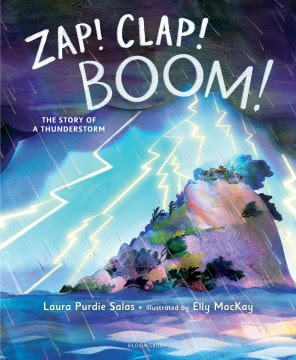
Zap! Clap! Boom! The story of a thunderstorm by Laura Purdie Salas, illustrated by Elly MacKay


I personally love thunderstorms and since I get frequent requests from teachers for weather books, I'm always willing to look at a new title. I had already preordered this one, based on the combination of author and illustrator and the subject, but I was pleased to get a review copy as well and it turned out to be well-worth purchasing!

Salas' poetic language follows the formation of a storm, from a clear day, to gathering clouds, to the first rumbles of thunder. The storm builds, with the titular refrain, ZAP! CLAP! BOOM! until it moves on and everything is clear and storm-washed, shining with raindrops and glowing from the sun. Back matter includes a more in-depth explanation of storm, how they form, what creates lightning and thunder, and further sources including videos. 

The art is created in Elly MacKay's unique overlay style, featuring three children whose skin is shown in shades of peach and brown, all with black hair, one short, one with two braids, and one with a waist-length sweep of straight hair. Images are overlaid with splashes of rain, cut paper and watercolors imitate the drip and sway of wet leaves and branches, and the end shines with golden light, the hills layered with oranges and greens and the sky a pale lavender.

Verdict: A lovely read-aloud, evoking the power and beauty of storms with added information to follow up children's interest. Pair with April Pulley Sayre's Raindrops Roll for a weather storytime or class unit on storms. Recommended.

ISBN: 9781547602254; Published March 2023 by Bloomsbury; Purchased for the library; Review copy provided by publisher

Tuesday, February 14, 2023

Molly on the moon by Mary Robinette Kowal, illustrated by Diana Mayo

It's rare for an an adult author to successfully step over into children's books, but Mary Robinette Kowal's debut picture book is charming, multi-layered, and a lovely read-aloud.

Molly, a little girl with brown skin, black hair, and red cheeks, travels to the moon in a rocket. In her new home, she lives underground with her mother and baby brother. There is very little space, so she takes only one toy, her stuffed lamb Lassie. But there are packing crates to be turned into a fort, a plastic panel becomes a cape, and cans become a tea set. When Lassie goes missing, Molly searches high and low, remembering to account for the lower gravity. Unfortunately, it turns out baby Luke is playing with Lassie and their tug-of-war sends him soaring to the roof. Molly is angry, especially when she is reprimanded by her mother, but then she realizes that while she has several toys to use with her imagination, Luke has nothing but his little pile of blocks. Relenting, with the help of her mother she shares the toys she has created and the two  play happily together, having a tea party on the moon.

An author's note explains why, if we moved to the moon, we'd have to live underground and the changes in gravity. Kowal also expands on the idea of playing and repurposing toys and using one's imagination. Mayo's soft illustrations, all in tones of blues and purple with spots of yellow light and red fabric, are created from pastels and perfectly portray the gentle loneliness of the moonscape and the quiet connections Molly and her brother form after their argument.

The quiet repetition of the text, especially at the beginning as Molly creates playthings, will make this an excellent read-aloud. The book can be explored on several different levels, as an informational book about space, gravity, and the moon, but also in the context of moving and adapting to a new home and making do with limited things. Apart from the gravity, Molly and her little family could be moving to a smaller place or living in temporary housing and the book gently coaxes readers to think about using - and sharing - what they have.

Verdict: A quiet but touching story, a unique addition to storytimes featuring space and/or moving. Recommended.

ISBN: 9781250259615; Published 2022 by Roaring Brook; Borrowed from another library in my consortium

Friday, January 13, 2023

Where we come from by Diane Wilson, Sun Yung Shin, Shannon Gibney, and John Coy, illustrated by Dion MBD


This is a beautiful book, expressively celebrating the similarities we share and the differences that make us unique. It begins with a smattering of colored dots across the universe, creating the outline of a human figure, "We come from stardust." It moves through early prehistory and into images from each of the creators' cultural backgrounds. They come from waving fields of grass, the Mni Sota Makhoche, from the comfort of a small Korean village, from a city in Michigan, from the north, from stories, from people across the world. Telling stories, celebrating seasons, creating family, sharing language, from difficult times of slavery, prejudice, and poverty, each person comes from a long history and a rich culture. They are formed not only by their ancestors and history but by their own childhoods, visiting the library, sharing with family, playing sports, growing up in the city or the suburbs. The story ends as it began, with a dark sky speckled with sparkling stars, but this time four unique but connected children move across it, created by stardust and stories, connected by family and future.

Back matter walks readers through each page spread, explaining the science and historical context both in a general way and specifically for the creators' own stories. There is a short section of pronunciation of non-English words, a thoughtful section on reflecting on our own backgrounds, including those with gaps or past trauma, and suggestions of children's books and adult books for further reading.

Verdict: This unique book would be the perfect selection to explore instead of the traditional "family tree" school assignment, helping students think about where they come from, their history and what's important to them, even if they don't have knowledge of immediate family. Recommended for libraries that serve elementary school populations.

ISBN: 9781541596122; Published October 2022 by Carolrhoda; Borrowed from another library in my consortium; Purchased for the library

Wednesday, November 23, 2022

Hello, moon by Evan Turk


Sometimes, well, often, I just don't get what people see in award-winning illustrators. Frankly, I have never appreciated Evan Turk's art. I feel like some of my patrons who just don't "get" graphic novels. However, I am really glad I took a chance and looked at this title, because finally I can really appreciate his unique style.

A child and parent, their skin glowing in warm oranges with swirling curls of brown hair, go out into the night to say hello to the moon. The night is rich with inky blue-black swirls, the moon a white, glowing circle. Their faces are washed into gray-blue by the light of the moon and the reader is carried across a series of paneled drawings showing moonlight and sunlight as the days pass. The next image of the golden-faced child shows a sliver of the moon in shadow, "Look! The Moon! Part of it is gone!"

Under the gaze of the child and their parent, the moon goes through its phases and the beauty and strangeness of the winter night, glowing under the light of the moon, is shown. Shadows on the bark of the birch trees look like eyes, cold water flows in swift ripples, and finally only their eyes show in the dark, waiting for the new moon to appear. But even when the moon is hidden, the sky is alive with deep blues and purples, to the sparkle of the stars. Swirling white lines take the child and parent up into the stars, making them part of the fantastic universe, until they return to their cozy home, ready to greet the new sliver of the moon.

Verdict: The simple text, a brief framing for the stunning depictions of the night sky and the moon in its phases, is perfectly matched with the art and this is a top choice for quieter, reflective storytimes, read-alouds to classrooms, and inspiration for art. Recommended.

ISBN: 9781534400801; Published September 2022 by Atheneum; Review copy provided by publisher

Monday, November 21, 2022

A Very Asian guide to Korean food by Michelle Li, illustrated by Sunnu Rebecca Choi


 I almost never review titles that aren't available through Baker and Taylor, my primary vendor, but I agreed to look at this title for several reasons - first, because we have a small population of Asian families in our area, primarily Japanese but also some Korean and Chinese families. They come as students to the university in a neighboring city, usually through the Kikkoman factory located in the area. Secondly, because we have waves of interest in manga and anime that often means I have younger kids, especially fifth graders, interested in Asian food, history, and culture and it can be difficult to find titles for them that are appropriate for their age range. So, I took a look at this in egalley and then in hard copy format.

The author created this celebration of Korean food after dealing with racist remarks on social media and to support kids dealing with bullying and othering about their culture. It's a slim volume, about 12" by 6" with paper over board binding and the back cover includes promotions from chefs and authors.

Each spread features a different Korean food, how it is prepared, and how it is served and eaten. There is also a "very" label. For example, the spread on bibimbap is labeled "Very Colorful" and includes a simple description of the dish and how it is made, how to pronounce it, and small paragraphs dotted around the illustration adding information like the sauce it is served with, how it is served, its history, and how people like to eat it. Labels include "Very Shareable," "Very Snackable," "Very Hot," and many more. The one thing that confused me was that all of the people depicted in the illustrations have an odd round circle on their face, contrasting with their skin color. I couldn't figure out if this was an idiosyncrasy of the illustrator's style or an artistic convention I'm not familiar with. Otherwise, the staged art clearly showed the illustrator's work with printmaking and the depictions of the foods are colorful and attractive. A variety of hair styles, body types, and races are shown in the people pictured. A recipe is included in the back.

Verdict: This isn't a storytime style book, more a browsing title or something school-age readers will enjoy sharing with an adult. If you have the audience for it, it's worth taking a little time to chase down a copy - it looks like it is available directly from the publisher only at this time. There are plans for publishing additional titles on different Asian cultures in the future and I hope they will be more widely available.

ISBN: 9781737240426; Published October 2022 by Gloo Books; Egalley and hardcover review title provided by publisher; Donated to the library

Tuesday, October 25, 2022

When the sky glows by Nell Cross Beckerman, illustrated by David Litchfield

 I absolutely judged this book by its cover. How could you not want that glorious explosion of pink? It turned out to be a really nice informational book about light in nature, from sunset to sunrise, including the aurora borealis and more.

The picture book opens with a sparkling yellow-gold sky and navy blue field, studded with glowing plants, introducing the glory of sunrise. A red-headed white girl wakes up early and marches out to the fields on a traditional farm, complete with red barn and farmer raking in the field. A smaller paragraph explains why we see certain colors at sunrise. Paired images and simple text then go on to explore the lightning storms of Lake Maracaibo, rainbows in Hawaii, a solar eclipse, sunset at a watering hole, and more, ending with sunset in the city and a Black boy going to sleep in a high-rise apartment.

There are some unique views of different light sources, like a discussion of photography at sunset that accompanies the blinding fire of light at the watering hole, the science behind auroras, fireflies, and more. The back matter includes a brief list of sources and recommended reading and a note about light pollution.

The digital art is dazzling, if not absolutely realistic, glowing with shades of yellow, orange, pink and red, studded with sparking stars and points of light. Having grown up in Texas, where the sun can be blindingly harsh, I felt that even the pictures of full sun softened the effects, and although the pictures are glorious they do have something of a sameness about them, repeating the sparkling, bright effects on each page. However, despite these quibbles, this is a lovely blend of story and information and would fit in well not only with storytimes but also with art projects or class discussions.

Verdict: For a preschool or toddler storytime, pair this with songs and rhymes about the sun, moon, and stars and art projects with sparkling foil, glitter, or paint. For elementary school-aged classes, put this together with books talking about the science of light, light pollution, and nocturnal and diurnal animals. Art teachers could have a lot of fun with as well, even with older kids, playing with light and photography. A beautiful and versatile title, recommended for most library and school collections.

ISBN: 9781534450394; Published September 2022 by Beach Lane Books; Review copy provided by publisher; Donated to the library

Tuesday, September 20, 2022

Do baby elephants suck their trunks? Amazing ways animals are just like us by Ben Lerwill, illustrated by Katharine McEwen


 This simple picture book blends animal and human behavior together for a look at how the young of various mammals behave.

The author speaks directly to the audience, asking them questions like "Has a grown-up carried you in their arms?" and then explaining how this behavior is seen in an animal, in this case an orangutan. The examples include elephants, lions, whales, and several other mammals. The font for the brief text is large and the text could be divided into just the question, using the book for dialogic reading, or including the longer explanatory paragraph for a slightly older audience. The final pages of the book show toddlers and infants, with a diversity of ethnicities, performing typical actions that mimic some of the activities in the book. The text says "The things that make us the same are as special as the things that make us different." and then listeners are asked to imagine being a different kind of animal.

The collage-style illustrations blend a number of textures and shapes together to create pictures of animals and their habitats that, while not having the detail of realistic or photographic illustrations, will still be familiar and easily identifiable for young listeners. 

Verdict: This is a strong choice for storytime and will appeal to toddlers and preschoolers. It can easily be expanded with extension activities or adapted for dialogic reading. Recommended.

ISBN: 9781536224047; Published June 2022 by Candlewick; Borrowed from another library in my consortium

Monday, September 12, 2022

Look and Listen by Dianne White, illustrated by Amy Schimler-Safford


 Lush colors and textures fill the pages of this sweet guessing game for young listeners.

The opening pages show a green landscape and a flower-bedecked house, with a child and dog starting down a pathway for a walk. The child has white skin and brown hair. Each landscape is introduced and then listeners are invited to guess the answer to rhyming couplets of what they see and hear. The game starts in a garden, a lush explosion of color surrounded by a picket fence, and readers can guess the buzzing sounds of a bee, the beating wings of a hummingbird, and the "lacy wings" of a butterfly. A green meadow with a stone wall, and a turquoise brook meandering between rocks offer the opportunity to find and guess deer, fish, and other occupants. The last few pages show thumbnails of the child in the different landscapes, looking and listening, and ending with them holding the dog and a bouquet of flowers. Back matter adds details for each ecosystem and creature.

The busy pictures mimic a thriving ecosystem with grasses, flowers, insects, animals, and plants in a happy disarray. Each picture offers not only clues to the guessing game, but a close inspection will reveal the actual creature hiding on the page, and then a clearer illustration on the following page. This makes it perfect for toddlers and preschoolers, but does form a little bit of an odd juxtaposition with the child, who appears to be a tween, not a young child.

Despite this minor quibble, it's a great addition to guessing game books and a strong choice for toddler storytimes, especially if you live in an area with a similar range of ecosystems and can pair it with outdoor programs encouraging similar expeditions to look and listen.

Verdict: A beautiful and fun book that encourages young observers and offers a range of extension activities for storytimes and programs from toddlers to preschoolers. Recommended.

ISBN: 9780823443468; Published June 2022 by Margaret G. Ferguson; Borrowed from another library in my consortium

Friday, August 26, 2022

To the front: Clara Barton braves the Battle of Antietam by Claudia Friddell, illustrated by Christopher Cyr


 Although this is in a picture book format, and the brief, poetic text mimics a picture book biography, it's neither a picture book aimed at young children nor a biography. Cyr's earth-hued pictures imbue the pages with a somber mood as Clara Barton, in her own words, tells readers of her journey to the devastating battlefield at Antietam.

Barton's own words, taken from her letters and memories, are mixed with the author's sparse prose as the horrors of the aftermath of war are shown through Clara's eyes and her courageous efforts to alleviate suffering bring her into contact with death, disease, and often despair. Although Cyr's art smooths over the gory horrors of the surgical tents and dying men, there is no mistaking the brutal aftermath of war, from crude surgery to lack of supplies and constant filth and gore. Lighter moments are illustrated with shafts of sunlight; when Clara Barton finds chests of supplies packed with cornmeal, and she herself is always accompanied with light into the darkest places, as she brings hope to all those she encounters.

Careful research concludes the story with a detailed explanation of Clara Barton's life, especially after the immediate events of the Battle of Antietam and the Civil War, including her friendship with Frederick Douglass and her support of suffrage and work as a humanitarian. Included is a list of bibliographical resources and sites to visit.

Verdict: This is a realistic but not over dramatized or gory introduction to the realities of war for middle grade readers. It would also be an excellent addition to a study of pivotal women in history and helps build a nuanced picture of the Civil War. A must have for most public libraries and school libraries, I strongly recommend it for teachers to include in discussions of and introductions to this time period in US history.

ISBN: 9781635923223; Published March 2022 by Calkins Creek/Astra; Borrowed from another library in my consortium

Monday, August 15, 2022

Brown is warm, black is bright by Sarah L. Thomson, illustrated by Keith Mallett


Mallett's beautiful art and Thomson's poetic text follows the girl on the cover through a celebration of the warmth and beauty of black and brown. The title pages show her joyously kicking through an explosion of red and yellow leaves, while her father rakes in the background. She enjoys the crisp brown of leaves, the mystery and splash of a black pool, the strength of a tree and t

he soaring flight of a crow. The story becomes more poetic equating black and brown with the hope of following a path home, the sweetness of her father's greeting, the richness of ideas coming from those before her, the beauty of the music she evokes from a cello. Black and brown is safe, warm and quiet as her father kisses her goodnight and she curls up with her puppy.

There have been many beautiful books being published recently that celebrate diversity, especially in skin tones. However, I find it difficult to get these to circulate or figure out how to fit them into a storytime. This may certainly be a failing on my part - I know many people have an audience for these type of "high-concept" books and I do get a lot of teacher requests for those geared more towards social-emotional learning and self-esteem, especially at the beginning of the year, but I've never figured out how to incorporate them into a storytime, especially for younger kids.

So, I was really excited when I saw the idea for this - a book that celebrates black and brown skin, but beginning with the framing of celebrating the colors that occur naturally in nature. Naturally, most of the book is framed by the season of autumn and I can never have too many season books. Moving on, it evokes the warmth of a bedtime story and the hope and upbeat feeling of the books that encourage resilience and hope in kids, which will hit the benchmarks my teachers look for. A book can be objectively beautiful, of great literary quality, and supporting the ideals of diversity that we all strive for, but still not the right fit for a specific audience - this book is perfect in combining the diversity I want to see in my collection with subjects that teachers and parents are looking for and which will make it a popular choice and, possibly, an enduring classic.

Verdict: If you long for beautiful and diverse high-concept books but know they won't circulate well for you, this is the book you need for your collection! If those high-concept books are easy circulators for you, this lovely book will be a wonderful addition. Either way, I recommend it for most collections.

ISBN: 9780316424196; Published August 2022 by Little Brown; F&G provided by publisher

Monday, August 8, 2022

Frog vs. Toad by Ben Mantle


 I had expected an informational picture book about the differences between these two amphibians, and that's certainly included, but what I really got was a raucous romp about getting along and resolving arguments.

Frog, his large yellow eyes bulging, snaps a juicy blue and pink fly for his dinner... but only a few seconds later, a big warty toad pops out and tries to snag the same fly! "This is the worst day ever!... I'm being eaten by two frogs!" complains the fly. Fortunately for the fly, it is immediately released as the insulted frog and toad begin exchanging insults over their respective skin, length of leg, smell.... soon they've attracted an audience, and backers on either side. The argument quickly devolves into a giant mud battle and there seems no end to the arguments until...

A new creature appears on the scene, to tell them they're all related in no uncertain terms and to end the story with a surprising, and humorous, twist. An explosion of greens and browns, interspersed with outrageous red, pink, and purple jungle flowers, cover the pages and the grinning mouths of the frogs and toads surround the two arguing protagonists as their exchange of insults gets sillier and sillier.

Verdict: Without an adult guiding the conversation, it's unlikely that this will translate to a discussion of overlooking each other's differences and focusing on our similarities, but it's certainly a funny way to teach the difference between frogs and toads and a rollicking read-aloud, regardless of message.

ISBN: 9781536223699; Published July 2022 by Candlewick; Borrowed from another library in my consortium

Thursday, July 28, 2022

Poo-Dunit? A forest floor mystery by Katelyn Aronson, illustrated by Stephanie Laberis


Every time the subject of Bigfoot (or our local cryptid, The Beast of Bray Road) comes up, I always remind people of the ultimate evidence of existence - show me the poop! And here it is, right on the cover in bold color and a visible smell...

Mouse pokes her nose outside her house one day, only to see a giant pile of scat, decorated with hairs and berries, and she quickly sets out to find the creator of this enormous pile of poop. She questions animal after animal, each one joining in the rhyme to describe their own feces, until the proud author of the poop is discovered - only to be eclipsed by an even bigger deposit!

Luckily, Mouse has lots of friends to help her clean up the mess and fertilize a fresh crop of flowers for her doorway to perfume the air in the future. Back matter describes the different scat left by each animal and gives a brief explanation of the benefits of manure, properly used of course. The story is told in brisk rhyme and the "icky" subject is dealt with briskly and humorously.

Laberis' digital illustrations show sharply-featured animals zipping around the landscape, all trying to avoid the smelly heap, and with cheesy grins on their faces as they confess to their own fecal specialties.

Verdict: Informational as well as funny, this is a good fit for any kids who like bathroom humor (i.e. nearly all of them) with a informational twist. Pair with some of the other books on the subject for an icky storytime, or pass on to classes teaching kids about natural behavior and tracking. Recommended.

ISBN: 9781536216370; Published June 2022 by Candlewick; Borrowed from another library in my consortium

Thursday, July 21, 2022

Read 'n' Play: What a submarine sees: A fold-out journey under the waves by Laura Knowles and Vivian Mineker


 Laura Knowles creates a really interesting range of informational picture books and I've never understood why her titles aren't more widely available - possibly because she often publishes through small presses perhaps. Anyways, it's always a surprise to see what she's created, but sometimes I don't want to risk it when my budget is small so I purchased this title personally through Amazon, with the intention of donating it to the library if it turned out to be something my patrons would like.

You can read this in multiple ways. If you start turning the thin cardboard pages like a traditional book, you will join three children in a yellow submarine exploring the bed of the ocean. They start in a reef, go past a pod of orcas in the ocean, then down into the dark by a hydrothermal vent and back up to the surface, where an unfortunate turtle is hunting jellyfish - and plastic bags. The last page gives some details and facts about submarines.

You can then turn the pages to go through the book "backwards" and learn about the history and different types of submarines, ocean creatures like jellyfish, coral, and anglerfish, and more general ocean facts like the zones and issues of plastic pollution.

The book can also be folded out into one long, continuous narrative. The information on the "back" of the pages matches the journey of the submarine on the "front" of the pages. The pictures are simple, but bright and colorful and the progression is easy to follow, with the informational text divided into short sections.

Verdict: This isn't a typical picture book and the paper over board binding and continuous fold-out will make it unlikely to last on a library shelf. However, it would make a great gift for a child who loves ocean science and a perfect accompaniment for a storytime or STEAM kit, which will be where I'll use it in our library.

ISBN: 9781913519216; Published July 2021 by Welbeck; Purchased via Amazon and donated to the library


Monday, May 30, 2022

Togo & Balto: The dogs who saved a town by Jodie Parachini, illustrated by Keiron Ward and Jason Dewhirst


In the fall of 2021, Albert Whitman launched a new series of informational picture books, Animalographies, featuring a variety of heroic or famous animals and their stories. I had looked at a few descriptions, but this was the first one I finally ended up reading (admittedly under the mistaken impression it was a chapter book).

Told as a narrative partially from the dogs themselves, this particular story is of the heroic race of Togo and Balto to get the diphtheria serum to Nome, Alaska. The introduction briefly mentions the use of sled dogs by indigenous peoples, then focuses on the story of the two dogs, focusing on Togo, who is less well-known than Balto. Togo tells the story of his training and early life, then explains the circumstances around their famous relay race and narrates the exciting events. Digital cartoons show a predominantly white cast with smiling cartoon dogs racing through the snow.

Back matter consists of a fact sheet on sled dogs and the use of Huskies as sled dogs in history.

Verdict: The writing is rather pedestrian, and the story greatly simplified, but kids who love true stories about animal heroes will be thrilled with this new series and I think most libraries will find it a popular title to have on the shelf.

ISBN: 9780807503829; Published April 2022 by Albert Whitman; Borrowed from another library in my consortium